Archive Box Management Database: Garment and Textile
Table of Contents
📖 Overview
Archive Box Management Database: Garment and Textile
This project showcases a complete relational database design for managing a university’s garment and textile archive collection. The system handles archive operations, including storage tracking, patron checkouts, environmental monitoring, and item preservation across multiple storage rooms. The project demonstrates:
- Conceptual design: ERD modeling with 19 normalized tables (up to 3NF)
- Implementation: MySQL database with triggers for automated workflows and data integrity
- Query development: Complex queries addressing real archivists, librarians, and administrators’ needs
Built using systematic database design principles from concept to working implementation, this project reflects graduate-level coursework in database systems.
🔑 Key Features
- Multi-Room Storage Management: Tracks archive boxes and items across physical locations with capacity monitoring
- Environmental Monitoring: Automated alerts for temperature/humidity violations to protect textile preservation
- Patron Checkout System: Complete workflow tracking from checkout to return with automated status updates
- Cascading Status Logic: Triggers automatically update item and box statuses based on operational events
- Cultural Classification: Organizes garments by cultural origin, time period, and textile type
- Condition Tracking: Documents preservation states and conservation needs for individual items
📋 Schema Overview
This database serves four primary user groups within the university archive:
| Stakeholder | Primary Responsibilities | Key Database Interactions |
|---|---|---|
| Archivists | Collection management, item processing, box organization | Catalog items, assign boxes, update locations, monitor conditions |
| Librarians | Patron services, checkout management, search assistance | Process patron requests, manage checkouts/returns, search collection |
| Administrators | Operations oversight, reporting, capacity planning | Generate reports, monitor space utilization, track shipments |
| Conservators | Preservation assessment, environmental monitoring, condition tracking | Record condition assessments, monitor environmental readings, flag preservation needs |
Database Design Principle: The three-tier structure ensures data integrity through dependency management while supporting diverse stakeholder workflows—from day-to-day patron checkouts to long-term preservation monitoring.
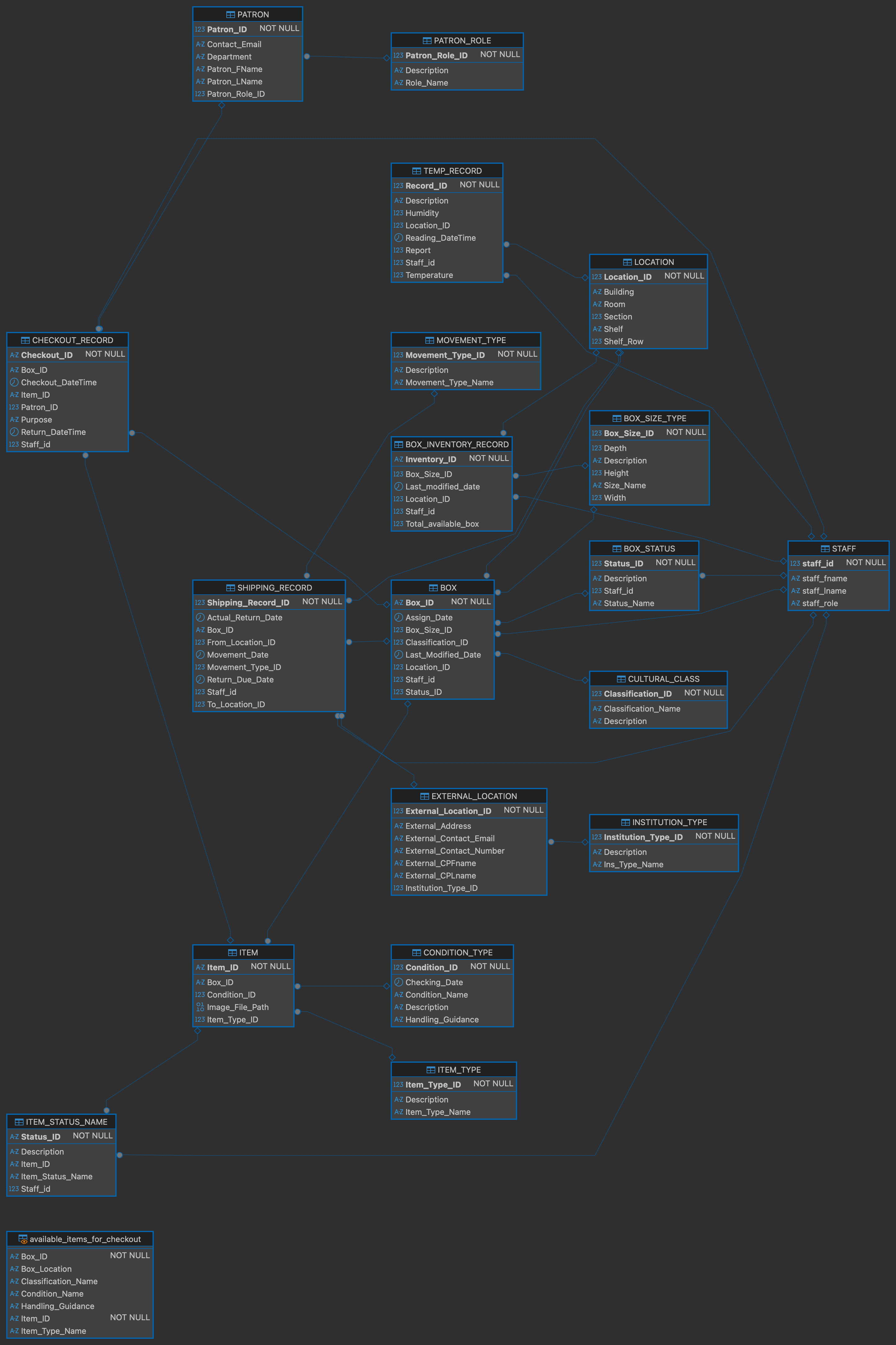 Image credit: Kelsey Kiantoro, 2025. ERD for Archive Box Database System.
TIER 1: FOUNDATION TABLES
| Table Name | Description |
|---|---|
STAFF | Archive personnel with role assignments |
BOX_SIZE_TYPE | Physical dimensions and specifications for archive boxes |
CULTURAL_CLASS | Cultural/geographic origin classifications for items |
ITEM_TYPE | Garment and textile type categories |
PATRON_ROLE | User access level definitions |
MOVEMENT_TYPE | Classification for box shipping/transfers |
INSTITUTION_TYPE | External organization categories |
CONDITION_TYPE | Item preservation state with handling guidance |
LOCATION | Physical storage locations (building/room/shelf) |
TIER 2: DEPENDENT TABLES
Dependencies: Tier 1
| Table Name | Description |
|---|---|
BOX_STATUS | Box availability states tracked by staff |
PATRON | Registered archive users with roles |
EXTERNAL_LOCATION | Off-site institutions for loans/exhibitions |
TEMP_RECORD | Environmental monitoring (temperature/humidity) |
BOX_INVENTORY_RECORD | Box capacity tracking by location |
TIER 3: CORE OPERATIONAL TABLES Dependencies: Tiers 1 & 2
| Table Name | Description |
|---|---|
BOX | Archive box records with location and status |
ITEM | Individual garment/textile items |
ITEM_STATUS_NAME | Item-level availability tracking |
CHECKOUT_RECORD | Patron borrowing transactions |
SHIPPING_RECORD | External shipment tracking with loan periods |
🗄️ Data Dictionary
Comprehensive metadata documentation for all foundation tables, including attribute definitions, data types, and example values.
→ View Complete Data Dictionary
💬 Sample Queries
This project includes 15+ complex queries demonstrating advanced SQL techniques:
- Transaction Management: Multi-step patron checkout with rollback handling
- Nested Subqueries: Multi-level filtering for available items
- Trigger Integration: Automated status cascading across related tables
- View-Based Operations: Complex joins for stakeholder-specific data access
- Conditional Logic: Environmental monitoring with alert thresholds
📋 View Complete Query Documentation →
Queries organized by stakeholder role: Archivist, Librarian, Administrator, Conservator
⚙️ Technologies Used
- Database: MySQL 8.0
- Database Management Tool: DBeaver, Postgresql, LucidChart for ERD Draft
- Design Methodology:
- Entity-Relationship Modeling (Crow’s Foot notation)
- Normalization (3rd Normal Form)
⚠️ Project Scope & Limitations
System Boundaries
This database manages physical box storage and movement only. The detailed garment and textile collection catalog (item-level metadata, provenance, conservation history) is maintained in a separate Collection Management System (CMS/TMS).
This system handles:
- Box location tracking and capacity management
- Patron checkout workflows
- External shipping logistics
- Environmental monitoring for storage areas
Out of scope:
- Detailed garment cataloging (fabric composition, measurements, maker attribution)
- Digital asset management (high-resolution images, 3D scans)
- Comprehensive provenance research
- Detailed conservation treatment records
Known Limitations
- Sample data only: Database contains representative test data, not production-scale records
- Single-user context: Designed for academic demonstration, not a multi-user production environment
- Simplified workflows: Some real-world archive processes are streamlined for clarity
- No authentication layer: User management handled externally (not in database scope)
📂 Repository Structure
archive-box-database-system/
│
├── docs/                                    # All documentation files
│   ├── data-dictionary.md                   # Metadata for Tier 1 foundation tables
│   ├── query_documentation.md               # Query overview and links
│   ├── sample_data_documentation.md         # Sample data explanation
│   └── images/                              # Visual documentation
│       ├── ERD-archive-boxes.png            # Entity-Relationship Diagram
│       ├── query6_workflow.png              # Q6: Item Return workflow
│       ├── query7_swimlane.png              # Q7: Available Items workflow
│       └── query8_workflow.png              # Q8: Checkout Transaction workflow
│
├── sql/                                     # Database implementation files
│   ├── schema/                              # Table creation scripts
│   │   ├── tier1_foundation_tables.sql      # 9 foundation tables (no dependencies)
│   │   ├── tier2_dependent_tables.sql       # 5 dependent tables (require Tier 1)
│   │   └── tier3_operational_tables.sql     # 5 operational tables (require Tiers 1 & 2)
│   │
│   ├── sample_data/                         # Test data insert statements
│   │   ├── sample_data_tier1.sql            # Foundation table data
│   │   ├── sample_data_tier2.sql            # Dependent table data
│   │   └── sample_data_tier3.sql            # Operational table data
│   │
│   └── query/                               # Query demonstration files
│       ├── query_01_foundational_operation.md    # Queries 1-3: Basic CRUD
│       ├── query_02_applied_operational.md       # Queries 4-5: JOINs & workflows
│       ├── query_06_item_return_processing.md    # Q6: Trigger automation
│       ├── query_07_available_items_check.md     # Q7: Nested subqueries
│       └── query_08_checkout_transaction.md      # Q8: ACID transactions
│
├── README.md                                # Project overview and main documentation
└── _config.yml                              # GitHub Pages configuration
📄 License
This project is provided for educational and portfolio-review purposes only.
Usage Restrictions
- This database system may NOT be used in any production environment without express written permission
- Commercial use requires explicit authorization from the author
- Academic study, review, and educational use are permitted
- Modifications for production deployment require author permission
For permission requests or inquiries, please get in touch with the author.
🌟 Author
Kelsey Kiantoro
A graduate student in Library and Information Science with an interest in database systems and information architecture. I specialize in translating complex organizational needs into systematic database solutions, with a particular interest in archival systems, metadata standards, and data-driven collection management.
This project represents my work in mastering database design principles—from conceptual ERD modeling through production-ready MySQL implementation with automated workflows and triggers.
Developed as the final project for INFO639: Database Design (Fall 2024)
🙏 Acknowledgments
- Course Instructor: Dr. Monica G. Maceli, Ph.D.
- Tools: MySQL 8.0, DBeaver Community Edition
- Methodologies: E.F. Codd’s relational model principles, systematic normalization approach
- Design Inspiration: Real-world university archive collection management workflows
Special thanks to Dr. Maceli for guidance on database design principles and normalization techniques, and for fostering a rigorous approach to systematic database development.